
Why the gap between early adopters and late adopters isn’t growing linearly—it’s compounding.
Last month, a friend of mine watched a coworker turn a two-week deliverable into a two-day one — and get the promotion that used to take three years to earn.
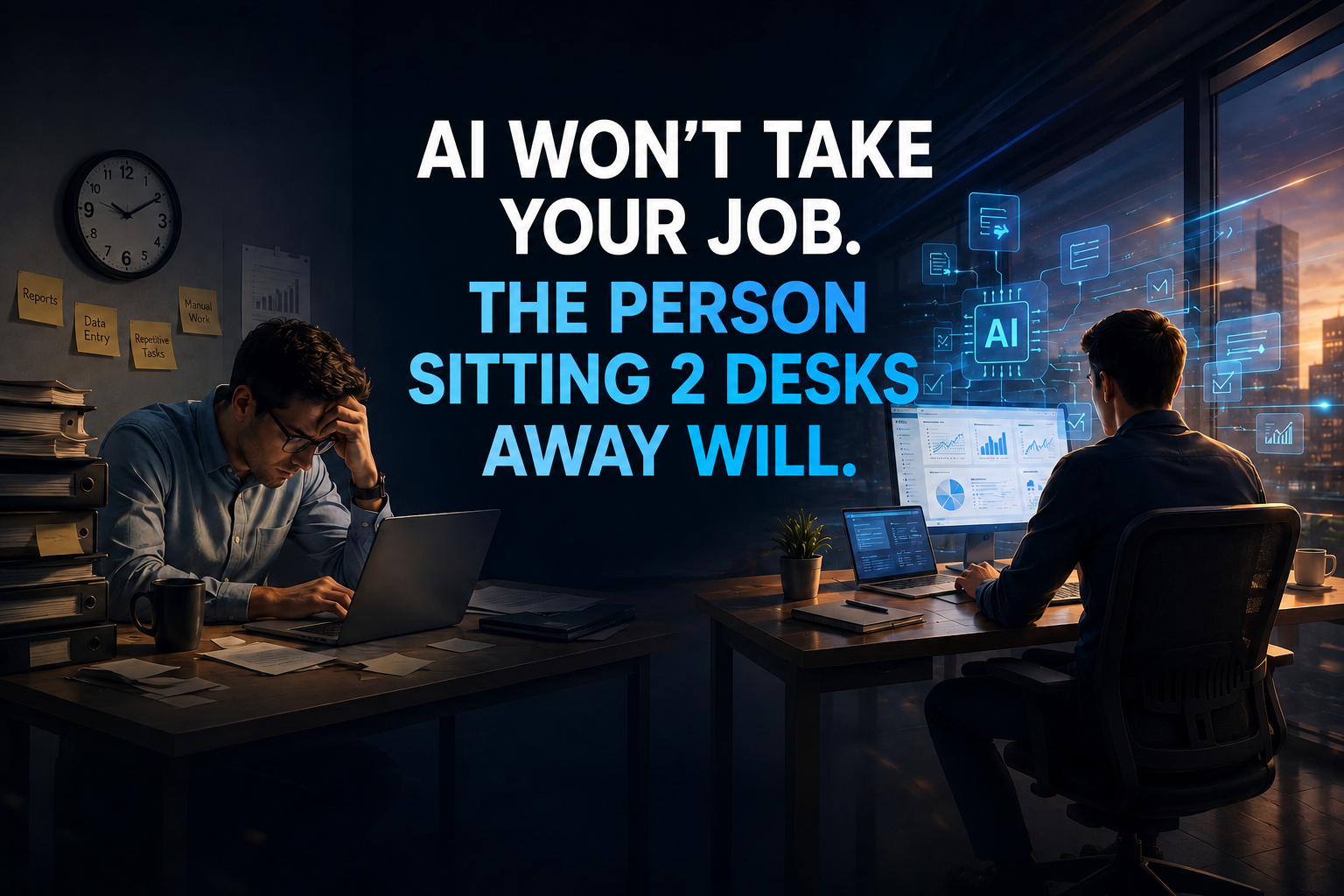
She didn’t get replaced by AI. She got out-paced by someone who knew how to use it.
That’s the plot twist nobody warned us about.
For the past two years, millions of professionals have been asking the wrong question—“will AI take my job?”—and it’s costing them time they simply don’t have to waste.
AI itself isn’t your competition. It doesn’t want your role, your clients, or your seat at the table. It has no ambition, no career goals, and no late-night anxiety about being left behind.
The real competition is quieter, subtler, and far closer to home:
- It’s the colleague two desks away who just figured out how to compress a week’s worth of research into two hours.
- It’s the freelancer undercutting your turn-around time by 50% without sacrificing quality.
- It’s the job applicant submitting a portfolio that looks like it took an agency to build, when it was really just one person and three well-crafted workflows.
The people who learn to leverage AI effectively are quietly pulling ahead in productivity, creativity, and strategic decision-making. They aren’t smarter than you. They aren’t more talented than you.
They simply adapted faster. And that difference compounds every single day you wait.
Human + AI: The Real Paradigm Shift
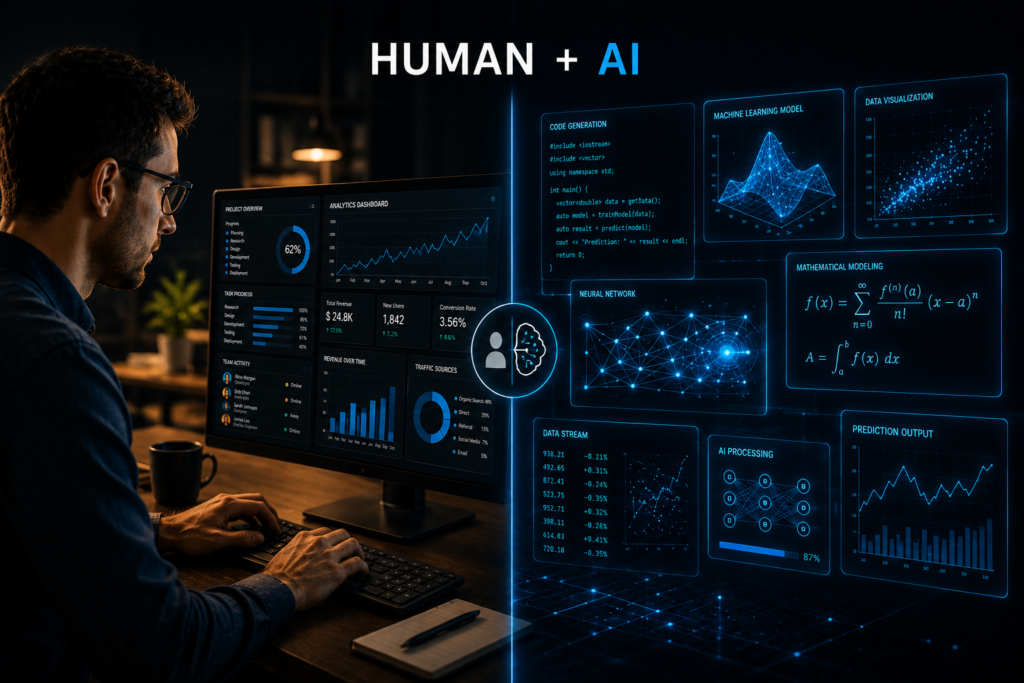
Popular culture portrays artificial intelligence as a sci-fi replacement for human effort. In reality, today’s AI performs best not as a substitute, but as an intellectual amplifier.
Think of AI as an extraordinarily fast, tireless assistant.
It can synthesize hundreds of pages of documentation in seconds, generate novel ideas, organize complex data, and draft foundational code. But it still relies entirely on you to ask the right questions, evaluate the outputs, spot subtle hallucinations, and supply human context.
[ Human Judgment ]
(Creativity, Context, Ethics)
+
[ AI Speed ]
(Synthesis, Pattern Match)
=
Unfair Career Advantage
Human creativity, emotional intelligence, leadership, and critical thinking remain completely irreplaceable. The professionals who thrive in the coming decade won’t be those who try to out-calculate the machine—they will be those who combine uniquely human intuition with computational speed.
Instead of asking: “Can AI do my job?”
Start asking: “How can AI absorb my repetitive work so I can focus on high-value strategy?”
| Old Belief | New Reality |
| “AI will replace me if I don’t compete with it.” | AI replaces tasks. Only other people replace people. |
| “I need to become technical to keep up.” | You need to become fluent — that’s a habit, not a degree. |
| “I’ll start using AI once I have more time.” | The people pulling ahead started with the time they already had. |
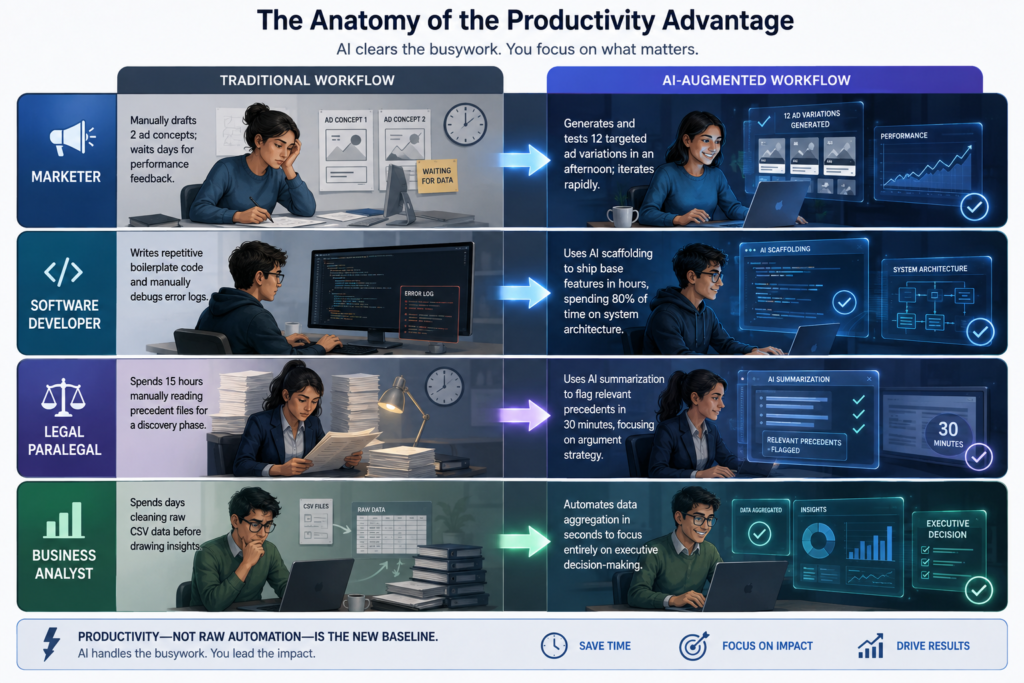
The Anatomy of the Productivity Advantage
One of AI’s greatest benefits isn’t replacing core work—it’s clearing out the busywork that quietly drains your day.
Consider the baseline shift across roles:
| Role | Traditional Workflow | AI-Augmented Workflow |
| Marketer | Manually drafts 2 ad concepts; waits days for performance feedback. | Generates and tests 12 targeted ad variations in an afternoon; iterates rapidly. |
| Software Developer | Writes repetitive boilerplate code and manually debugs error logs. | Uses AI scaffolding to ship base features in hours, spending 80% of time on system architecture. |
| Legal Paralegal | Spends 15 hours manually reading precedent files for a discovery phase. | Uses AI summarization to flag relevant precedents in 30 minutes, focusing on argument strategy. |
| Business Analyst | Spends days cleaning raw CSV data before drawing insights. | Automates data aggregation in seconds to focus entirely on executive decision-making. |
In every case, the advantage doesn’t come from the tool working alone. It comes from enabling humans to spend less time on manual collection and more time on high-stakes problem solving.
Productivity—not raw automation—is the new baseline.
The Compounding Gap: Why Waiting Is Exponentially Costly
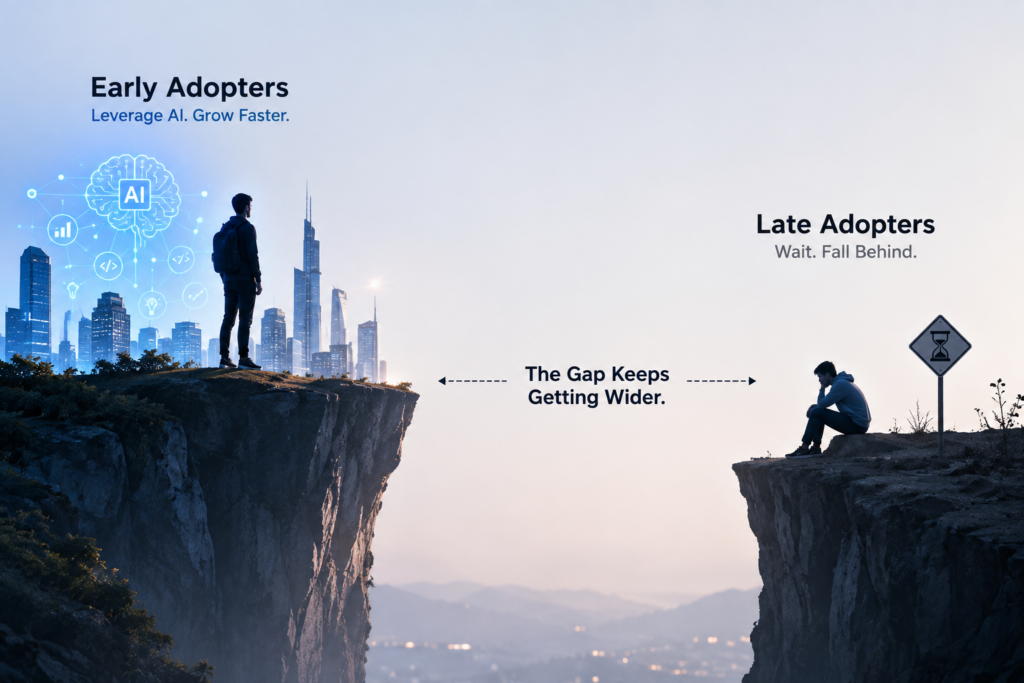
Here is the part of the shift that doesn’t get talked about enough: The distance between AI-fluent and AI-resistant professionals isn’t growing at a steady, linear pace. It’s compounding.
Someone who learns to use AI effectively today isn’t just “10% faster” than you. They are building a larger portfolio, faster feedback loops, and more repetitions in less time.
Every project completed faster becomes a chance to learn, refine, and take on the next challenge sooner. Over months and years, these small, repeated operational advantages stack on top of each other — the way interest compounds quietly in an account you forgot you opened.
Linear vs. Compounding Career Trajectory
[Early Adopter] ———————-> (Exponential Output & Speed)
/
/ <– The Gap Compounds
/
[Late Adopter] ———————-> (Linear Traditional Output)
Waiting a year to adapt doesn’t cost you 12 months of progress. It costs you the compounded advantage that early adopters have been quietly stacking the entire time.
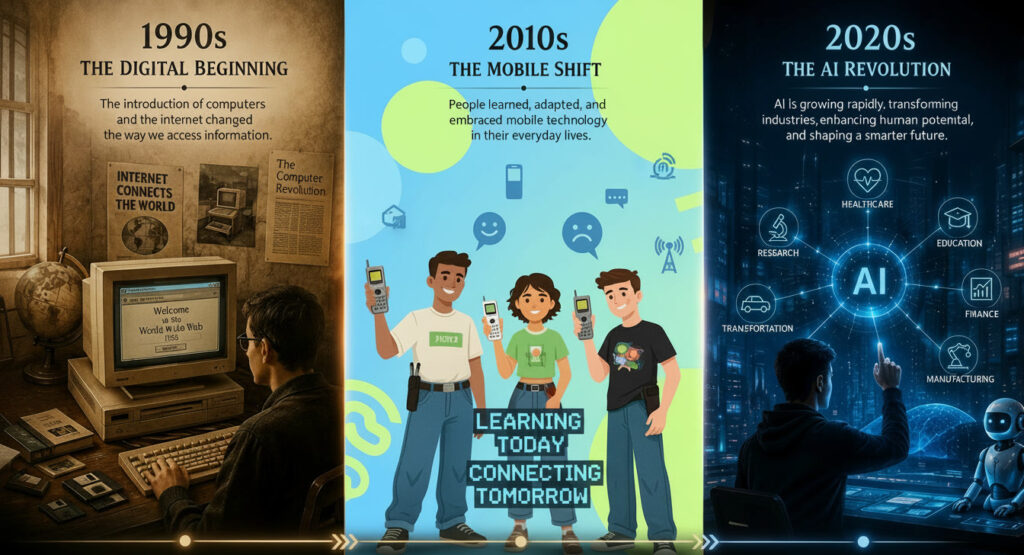
1995 Internet vs. 2026 AI: History Repeating Itself
History offers a clear mirror here.
In the mid-1990s, learning how to navigate the internet or use a personal computer wasn’t a specialized engineering skill—it was becoming the fundamental baseline of professional literacy.
Businesses and professionals who embraced digital tools early gained a durable, multi-decade advantage. The ones that treated computers as optional spent the next decade scrambling to catch up—and many never did.
AI is operating on the exact same playbook, but at ten times the velocity. AI literacy is no longer a niche technical skill for data scientists; it is basic operational fluency for every knowledge worker.
| “The cost of adapting today is an afternoon. The cost of adapting in three years is your entire career trajectory.” |
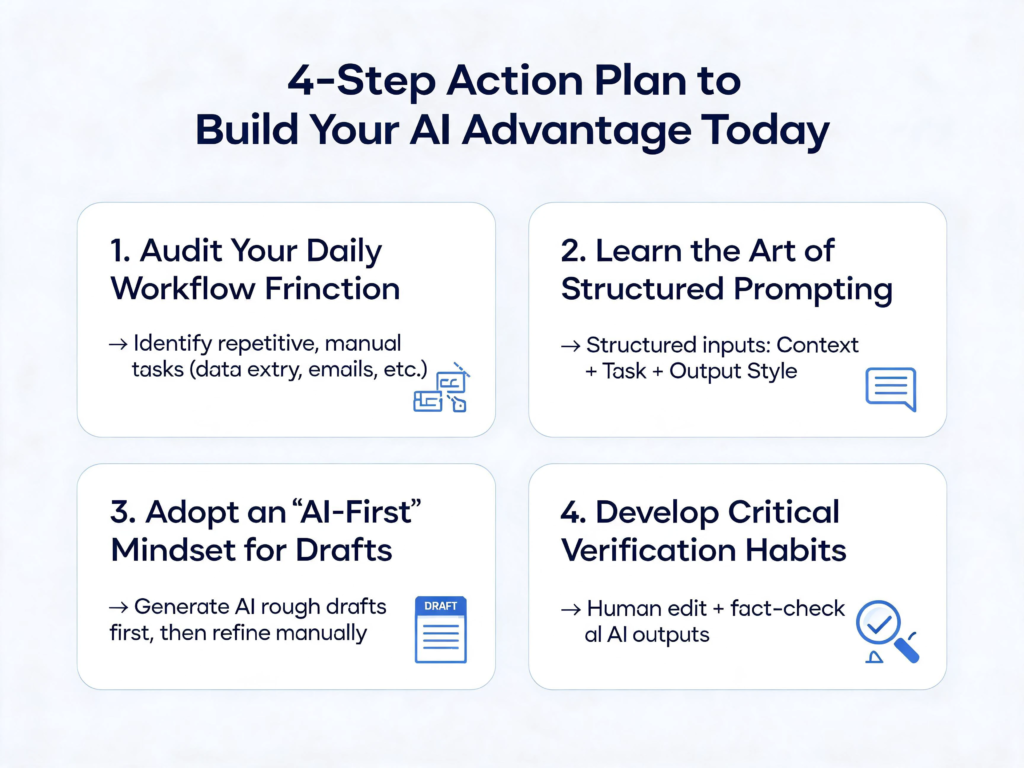
A 4-Step Action Plan to Build Your AI Advantage Today
You don’t need a degree in computer science to become AI-fluent. You simply need a systematic approach to integrating these tools into your existing daily routine:
1
Audit Your Daily Workflow Friction
Identify the 20% of your job that takes 80% of your grunt work
List every task you complete during the week that feels repetitive, manual, or administrative (e.g., formatting emails, summarizing meeting notes, structuring outlines, cleaning data). These are your primary targets for AI integration.
2
Learn the Art of Structured Prompting
Master the input before worrying about the output
Stop treating AI tools like a Google search bar. Give them a Role, Context, Specific Constraints, and a Clear Formatting Request. The better your input context, the higher the quality of your output.
3
Adopt an ‘AI-First’ Mindset for Drafts
Build micro-habits rather than trying to automate everything at once
Before starting any document, code file, or strategy outline from a blank page, spend 60 seconds asking an AI model to generate a rough draft or bulleted structure. Never start from scratch again.
4
Develop Critical Verification Habits
Protect your professional credibility
Always act as the executive editor of your AI outputs. Fact-check data, verify citations, align tone with your personal voice, and ensure ethical compliance. AI builds the baseline; your human judgment provides the final polish.
The Choice Ahead
The future will not belong to AI alone. It will belong to the people who learn to collaborate with AI better than everyone else.
This isn’t a call to panic, and it isn’t a warning about human obsolescence. It is an invitation.
AI itself is not your competitor. The real competition comes from the people around you who are choosing to adapt today—and the good news is that becoming one of them is entirely within your control.
So the question isn’t whether AI will transform your industry—it already has.
Here’s the smallest possible first step: open any AI chat window right now, paste in one task you were about to do manually, and ask it to take a first pass. That’s it. That’s the whole on-ramp.
The real question is: A year from now, will you be the one who adapted early, or the one still wondering what happened?
The title itself immediately grabs attention, and I really liked the perspective you’ve taken on AI and the changing nature of competition in the workplace. Instead of simply portraying AI as something to fear, you’ve highlighted how the people who learn to adapt and use new technology effectively may have an advantage
Great choice of topic and a really thought-provoking piece. Keep up the great work! 🔥👏
Thank you for the appreciation. Do share any suggestions or ideas you have with us.